Measurements
FLITS reports measurements from the current prepared session state.
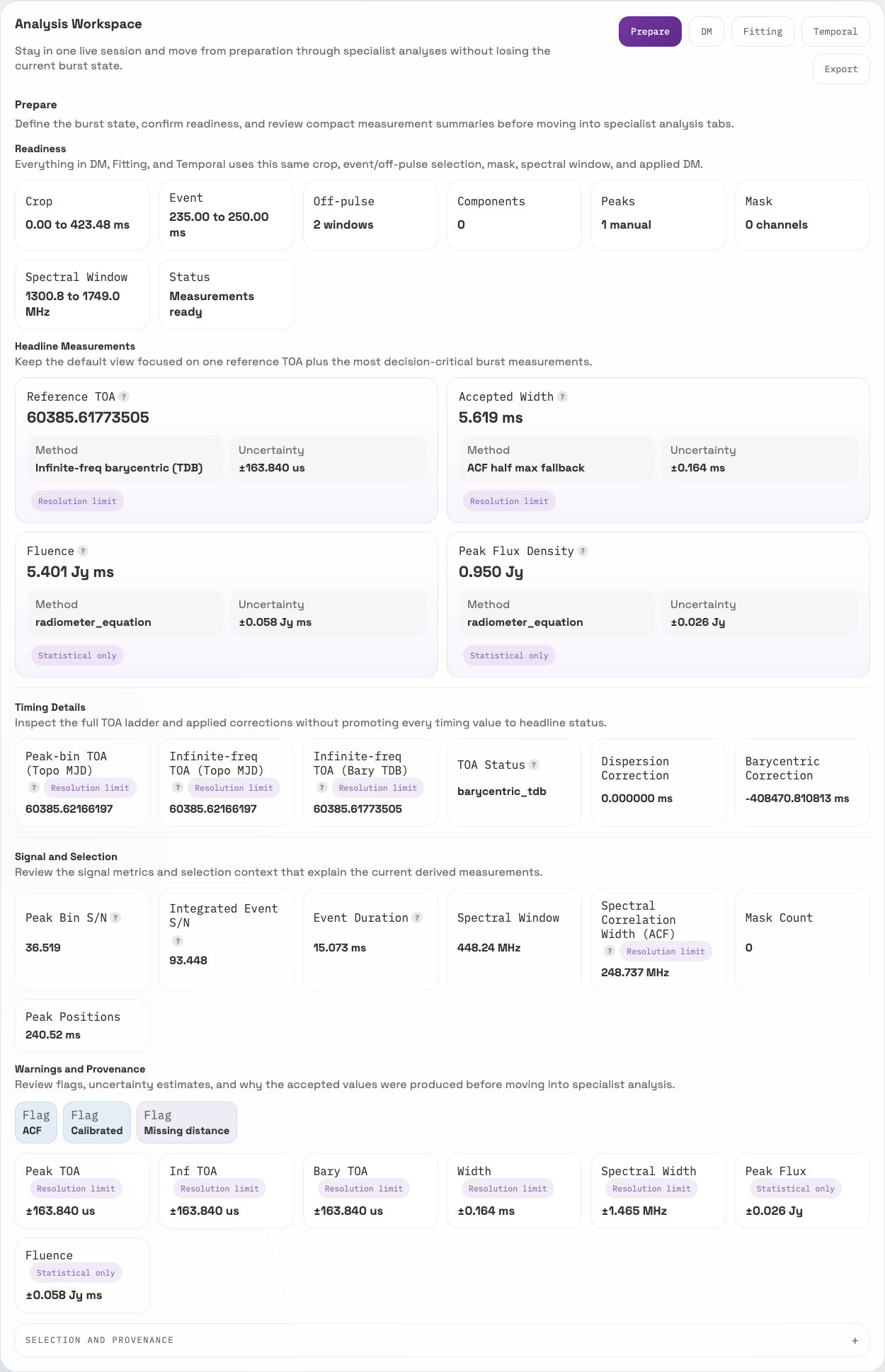
The Prepare tab groups selection readiness, headline measurements, timing details, and uncertainty flags. These values come from the GBT guided workflow; its absolute TOA fields are not part of the validated reference calculation.
Core outputs
The measurement workflow can report:
- fluence in Jy ms, when an SEFD is available
- peak flux density in Jy, when an SEFD is available
- event duration in ms
- spectral extent in MHz
- peak-bin topocentric/source-header TOA (
toa_peak_topo_mjd) - infinite-frequency topocentric TOA (
toa_inf_topo_mjd) when FLITS knows the dedispersion reference frequency - barycentric infinite-frequency TDB TOA (
toa_inf_bary_mjd_tdb) when source position, observatory location, and time-scale metadata are complete - one-dimensional Gaussian fits for selected burst regions
Calibration note
Flux and fluence require calibration information. If FLITS can identify a known observing setup, it may provide a default SEFD. Otherwise use the generic preset or specify an SEFD explicitly.
Without an SEFD, FLITS can still report selection- and timing-related outputs, but not calibrated flux-density values.
Uncertainties, and what FLITS will not claim
Every reported quantity carries its own uncertainty and its own classification of what that uncertainty means. FLITS distinguishes two cases, and refuses to blur them:
| Classification | Meaning |
|---|---|
formal_1sigma |
The statistical term and the systematic terms it needs were both available, and are combined in quadrature. This is a complete 1-sigma uncertainty. |
statistical_only |
Only the statistical (radiometer-noise) term is known. The systematic contribution is missing, so the stated value is a lower bound on the true uncertainty. |
For flux-like quantities the systematic term that matters is the fractional
uncertainty on the SEFD. Supply it as sefd_fractional_uncertainty when opening
the session:
session = BurstSession.from_file(
    "burst.fil",
    dm=527.65,
    sefd_jy=10.0,
    sefd_fractional_uncertainty=0.1,  # 10% SEFD uncertainty
)
Without it, FLITS still reports a fluence — the statistical part is real and
useful for relative comparisons — but marks it not publishable and records
why. A fluence quoted from a statistical_only result understates its
uncertainty, often by a large factor, because SEFD uncertainty typically
dominates.
Each quantity also records the basis of its uncertainty in words: which noise reference was used, and which terms were combined. That text is carried into exports, so a number in a table can be traced back to how it was derived without rerunning anything.
Distance-dependent quantities behave the same way: isotropic energy needs
distance_fractional_uncertainty before it is reported as a formal uncertainty.
Check the flags before quoting a number
measurement_flags records what was missing or suspect —
missing_sefd, missing_sefd_fractional_uncertainty, edge_clipped and
others. They are the fastest way to see whether a value is ready to use.
Provenance matters
Measurements depend on:
- the event window
- manual peaks, when they fall inside the selected event window
- the off-pulse definition
- the selected spectral extent
- the applied channel mask
- the current DM and reduced analysis state
- timing metadata: source position, observatory location, time scale, time reference frame, and dedispersion reference frequency
Interpret exported values together with the stored provenance, not as context-free numbers.
TOA Timing Chain
FLITS V1 still uses a peak-bin estimator for TOA. The primary value is the time
of the strongest event-window bin, or a manual peak only when that manual peak is
inside the current event window. toa_topo_mjd and mjd_at_peak are retained as
compatibility aliases for toa_peak_topo_mjd.
The infinite-frequency correction subtracts the cold-plasma dispersion delay from the finite dedispersion reference frequency to infinity:
delay_ms = 1000 * DM / (2.41e-4) * reference_frequency_mhz^-2
This value is reported as dispersion_to_infinite_frequency_ms. The correction
is only applied when FLITS can identify a trustworthy reference frequency. For
ordinary FLITS integer-bin dedispersion this is the highest channel frequency.
Public CHIME catalog waterfalls are treated conservatively: their public file
format does not by itself prove the reference frequency, so FLITS leaves the
infinite-frequency TOA unavailable unless stronger metadata are supplied.
The barycentric value uses Astropy Time, EarthLocation, and SkyCoord to add
the Solar-System barycentric light-travel-time correction to the infinite-
frequency topocentric TOA, then reports the result in TDB. It requires:
- source RA and Dec in ICRS decimal degrees
- a complete observatory longitude, latitude, and height
- a supported input time scale: UTC, TDB, TT, or TAI
- topocentric input times
If a header says the data are already barycentric or pulsarcentric, FLITS does
not apply another barycentric correction. The measurement payload records
toa_status and toa_status_reason so exports show whether the chain stopped at
the peak-bin value, reached infinite-frequency topocentric timing, or reached
barycentric TDB timing.
These corrected TOAs are useful for consistent reporting, but they are still resolution-limited because the V1 estimator is the selected time bin, not a centroid, template, or likelihood-model TOA with a formal statistical uncertainty.
Event duration versus burst width
The event duration is the manually selected event-window span. It is useful session metadata, but it is not automatically the same thing as a model-independent burst-duration estimate or the same thing as a fitted component width.
Width methods normally run the configured off-pulse Monte Carlo uncertainty
trials. Large population pipelines that calibrate uncertainties end-to-end can
set WidthAnalysisSettings(uncertainty_trials=0) to compute the width values
without this per-burst bootstrap. Such results carry the
uncertainty_disabled quality flag and do not report a width uncertainty.